
A Complete, Easy-to-Understand Guide by Padmashree Diagnostics, Vijayanagar, Bangalore
Getting a notification that your blood test report is ready can feel exciting. It can also feel a little confusing.
Numbers and reference ranges rarely come with a plain explanation. Yet blood tests guide most of the decisions doctors make about your care.
This guide gives you a simple blood test report analysis. You’ll learn how to read blood test results.
You’ll also learn when doctors order blood tests. We’ll cover key test types, like CBC, sugar, lipids, and liver and kidney panels. Padmashree Diagnostics has served Vijayanagar and greater Bangalore since 2000. We believe every patient deserves a report they can understand.
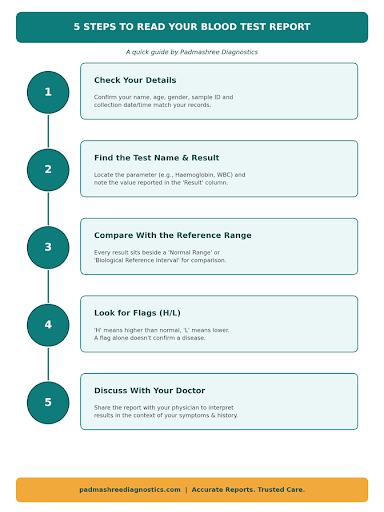
How to Check Your Blood Test Report
Most Indian labs, including Padmashree Diagnostics, format reports the same way. Your details sit at the top. Below that, a table lists each parameter, your result, and a reference (normal) range. Here’s how to read blood test report layouts step by step.
1. Verify Your Personal Details
Confirm your name, age, gender and sample date are correct-reference ranges vary by age and gender.
2. Locate the Test Name and Result
Each row lists a parameter, like Haemoglobin or Fasting Blood Sugar, next to your measured value and unit (mg/dL, g/dL, mIU/L).
3. Compare With the Reference Range
The blood test normal range shows where most healthy people fall. It isn’t an exact cutoff between healthy and unhealthy.
4. Note Any Flags
Labs mark abnormal results with an ‘H’ (high) or ‘L’ (low). High levels of a marker like blood sugar or cholesterol mean look closer-not an automatic diagnosis.
5. Take It to Your Doctor
Your doctor reads results alongside your symptoms and history. Bringing past reports helps track trends over time.
A quick-reference table of what these tests measure:
| Test Parameter | What It Measures | Typical Adult Reference Range* |
| Haemoglobin (Hb) | Oxygen-carrying capacity of blood | 13–17 g/dL (men), 12–15 g/dL (women) |
| WBC Count | Immune system / infection-fighting cells | 4,000–11,000 cells/mcL |
| Platelet Count | Blood clotting ability | 1.5–4.5 lakh/mcL |
| Fasting Blood Sugar | Blood glucose after 8+ hrs fasting | 70–100 mg/dL |
| HbA1c | Average blood sugar over 3 months | Below 5.7% |
| Total Cholesterol | Overall lipid/fat levels | Below 200 mg/dL |
| Creatinine | Kidney filtration function | Male: 0.66-1.25 mg/dl Female: 0.52- 1.04 mg/dl |
| TSH | Thyroid gland activity | 0-<1week: 1.05-36.10 1 week-20 years: 0.860-5.70 21-54 years: 0.4-4.2 55- 100 years: 0.5-8.9 As per ACOG recommendation For pregnancy: First trimester: 0.1-2.5 Second trimester: 0.2-3.0 Third: 0.3-3.0 |
*Ranges can vary slightly between labs and should be read alongside the range on your own report.
When Would I Need to Have a Blood Test?
So, when do I need a blood test? Not only when you’re unwell. Doctors order them for routine prevention and to monitor existing health conditions. Common scenarios:
| Situation | Why a Blood Test Helps |
| Annual/preventive health check-up | Detects silent issues like high sugar, cholesterol or anaemia early |
| Unexplained fatigue or weakness | Screens for anaemia, thyroid disorders or vitamin deficiencies |
| Fever, infection or inflammation | CBC and CRP help identify infection type and severity |
| Managing diabetes, thyroid or heart disease | Regular monitoring tracks treatment effectiveness |
| Before surgery or a procedure | Confirms fitness for anaesthesia and checks clotting factors |
| Pregnancy care | Monitors haemoglobin, blood group, infections and blood sugar |
| Unexpected weight change | Checks thyroid function and blood sugar levels |
| Family history of chronic disease | Enables early risk screening for diabetes, heart or kidney disease |
As a rule, book a blood test if you have persistent fatigue or unexplained weight changes.
Do so if you have a fever that lasts more than two days.Also book one for unusual blood sugar levels.Book a test if it has been over a year since your last check-up.
Types of Blood Tests
Blood tests are grouped by what they measure. Padmashree Diagnostics offers a wide range of tests including CBC, sugar, lipid, liver and kidney panels. The most common types of blood tests:
| Test Type | Common Tests Included | Purpose |
| Complete Blood Count (CBC) | Hb, RBC, WBC, platelets | Overall blood health, anaemia, infection screening |
| Blood Sugar Tests | FBS, PPBS, HbA1c | Diabetes screening and monitoring |
| Lipid Profile | Total cholesterol, LDL, HDL, triglycerides | Heart disease risk assessment |
| Liver Function Test (LFT) | SGOT, SGPT, bilirubin, albumin | Liver health and damage detection |
| Kidney Function Test (KFT) | Creatinine, urea, uric acid | Kidney performance evaluation |
| Thyroid Function Test (TFT) | TSH, T3, T4 | Metabolism and thyroid gland activity |
| Coagulation Profile | PT, INR, APTT | Blood clotting assessment, pre-surgery screening |
| Vitamin & Mineral Panels | Vitamin D, B12, Iron studies | Nutrient deficiency screening |
Complete Blood Count (CBC) is the most common blood test doctors order. It counts red cells, white blood cells and platelets for a snapshot of your overall health. White blood cells are part of your immune system; a raised count often signals infection, a low count a weakened immune response. A blood glucose test, like fasting blood sugar or HbA1c, tracks your blood sugar levels to screen for diabetes.
Your lipid profile monitors cholesterol levels, including LDL (‘bad cholesterol’) and total cholesterol, both tied to heart disease risk. Doctors often order liver tests (SGOT, SGPT, bilirubin) with kidney tests.
Some countries bundle them as a Comprehensive Metabolic Panel (CMP). Thyroid function tests (TSH, T3, T4) show how well your thyroid controls metabolism.
A coagulation profile checks how well your blood clots before surgery.
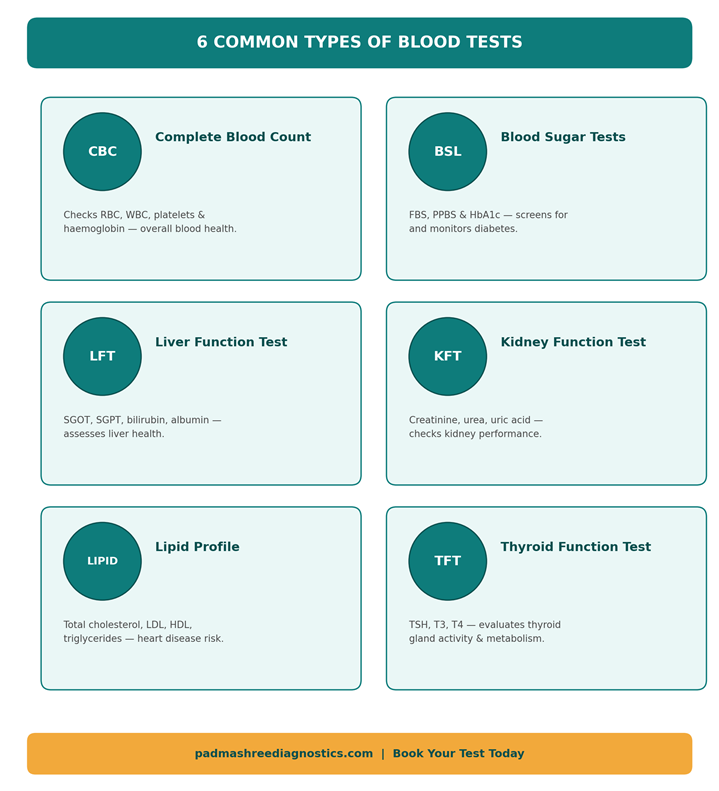
Infographic: 6 common types of blood tests and what they check
Why Choose Padmashree Diagnostics for Your Blood Tests
• NABL-oriented quality processes and advanced lab equipment for accurate results
• Experienced pathologists and phlebotomists for comfortable sample collection
• Affordable individual tests and health check-up packages
• Digital reports for faster access
• Trusted by the Vijayanagar, Bangalore community since 2000
Getting Your Blood Test Report in Bangalore
For a reliable blood test report Bangalore families trust, choose Padmashree Diagnostics in Vijayanagar. We pair skilled staff with modern lab equipment, so you know exactly what your tests measure-and what your numbers mean.
Ready to get tested? Book your blood test appointment or explore our full range of lab and diagnostic services.

