
Hematology (Haematology) Lab in Vijayanagar, Bangalore
Padmashree Diagnostics’ Hematology Department combines advanced laboratory technology with the experience of consultant pathologists to deliver accurate, timely, and clinically significant blood test results. We offer routine and specialized hematology tests for patients of all ages. We support diagnosis, monitoring, and management of blood disorders in Vijayanagar, Bangalore.
What Hematology Tests Tell Your Doctor
Hematology tests check your blood cells and clotting factors. They help find anemia, infections, bleeding disorders, and blood cancers. They also help monitor ongoing treatment.
Your doctor may order these tests during a routine check-up. They may also use them to check symptoms like fatigue, unexplained bruising, or repeated infections.
Complete Blood Count (CBC) – The Most Common Test
A Complete Blood Count (CBC) is the most common lab test. It gives a clear picture of your overall health in one test. A Peripheral Blood Smear Examination reviews every abnormal or clinically significant CBC finding. This helps our pathologists spot subtle changes that automated analyzers may miss.

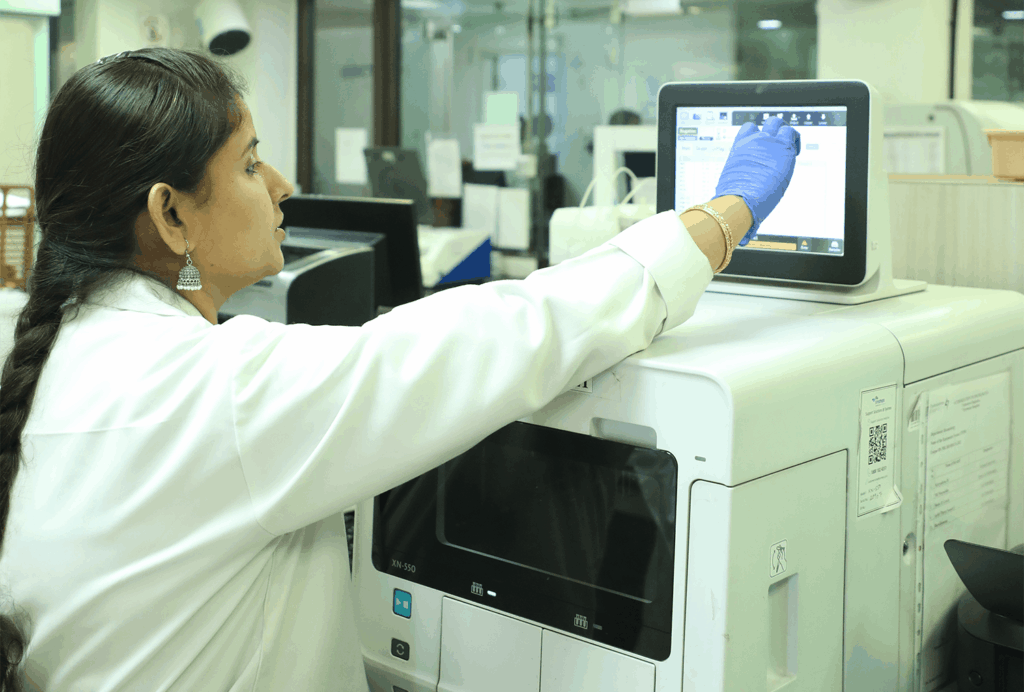
Advanced Analyzer Technology
Our Sysmex XN-1000 and XN-550 Hematology Analyzers use advanced fluorescence flow cytometry technology for accurate, reliable blood analysis. These advanced analyzers better detect immature blood cells, nucleated red blood cells, platelet issues, and other key findings.
Standard analyzers may miss these findings.
Blood Grouping, Typing & Coombs Testing
For blood grouping, blood typing, and Coombs testing, we use the Ortho Clinical Diagnostics Gel Card System. It is a well-accepted technology known for excellent accuracy, reproducibility, and reliability. This advanced platform minimizes manual errors and ensures dependable transfusion-related testing, essential before surgery, during pregnancy, and for blood donation compatibility.

Quality You Can Trust
Why Choose Padmashree Diagnostics for Hematology?
- Advanced Sysmex XN-Series Hematology Analyzers
- Ortho Clinical Diagnostics Gel Card Technology for blood grouping and Coombs testing
- Comprehensive routine and specialized hematology investigations
- Accurate detection of blood cell abnormalities
- NABL-accredited laboratory following ISO 15189 quality standards
- Fast turnaround time with reliable reporting
- Expert consultant pathologist review of abnormal findings
- Home sample collection available across Vijayanagar and nearby areas
- Accurate, dependable, and clinically relevant reports you can trust
Whether you need a routine health check-up, an anemia test, or transfusion testing, our Hematology Department can help. Our team also diagnoses blood disorders. We provide accurate results. These results help your doctor make informed clinical decisions.
When Your Doctor May Order a Hematology Test
- Unexplained fatigue, weakness, or pale skin - possible anemia
- Frequent infections, fever, or swollen lymph nodes
- Easy bruising, prolonged bleeding, or clotting concerns
- Pre-surgery or pre-transfusion compatibility screening
- Pregnancy antenatal screening and Rh compatibility checks
- Monitoring known blood disorders (thalassemia, sickle cell disease) or chemotherapy response
List of Hematology Tests
The existing 38-test index is comprehensive; group it under the sub-headings below so both users and AI crawlers can scan it quickly. (Keep the searchable/filterable list functionality already on the page.)
- CBC, Hemoglobin, Total WBC Count, Differential Count, ESR, PCV, Platelet Count
- MCV, MCH, MCHC, RDW-CV, Red Blood Count, Reticulocyte Count
- Prothrombin Time, Partial Thromboplastin Time, Bleeding & Clotting Time, D-Dimer
- ABO/Rh Grouping, Direct & Indirect Coomb’s Test
- Peripheral Smear, Peripheral Smear for Microfilaria, Hb Variant Studies, LE Cell Phenomenon, Malarial Parasite Thick & Thin, Rapid Malarial Test
- ANC, AEC, ALC, AMC, ABC, Absolute Eosinophil Count (automated/manual), Sputum for Eosinophil Count
- Determines blood group and Rh factor status, essential for safe blood transfusions, pregnancy management, and organ transplantation compatibility assessment.
- Identifies abnormal hemoglobin variants to diagnose thalassemia, sickle cell disease, and inherited hemoglobin disorders accurately in patients.
- Measures absolute white cell subtypes to assess immune status, infections, allergies, hematological disorders, and treatment response accurately.
- Measures eosinophil levels to diagnose allergies, parasitic infections, asthma, autoimmune disorders, and monitor response to therapy.
- Measures eosinophil levels to diagnose allergies, parasitic infections, asthma, autoimmune disorders, and monitor response to therapy.
- Evaluates lymphocyte levels to assess immune competence, viral infections, immunodeficiency states, and hematological malignancies accurately.
- Assesses platelet function and coagulation pathway efficiency to evaluate bleeding disorders and clotting abnormalities clinically.
- Measures time taken for blood to clot, helping evaluate coagulation cascade function and diagnose bleeding disorders.
- Haemoglobin (Hb)
- Red Blood Cell (RBC) Count
- PCV / Hematocrit
- MCV
- MCH
- MCHC
- RDW-CV
- Neutrophils
- Lymphocytes
- Eosinophils
- Monocytes
- Basophils
- Platelet Count
- Detailed evaluation of blood components including counts and indices to diagnose anemia, infections, inflammation, and hematological disorders.
- Detects antibodies bound to red cells diagnosing autoimmune haemolytic anaemia and transfusion reactions accurately in clinical haematology laboratory testing settings.
- Identifies free circulating antibodies in serum to assess transfusion compatibility, haemolytic disease, and antenatal antibody screening accurately.
- Measures fibrin degradation products to assess thrombosis, pulmonary embolism, disseminated intravascular coagulation, and clot breakdown activity.
- Calculates percentage distribution of white blood cell types to evaluate infections, inflammation, allergies, leukaemia, and immune response status.
- Measures erythrocyte sedimentation rate to assess inflammation, infections, autoimmune diseases, and chronic inflammatory conditions monitoring.
- Measures erythrocyte sedimentation rate to assess inflammation, infections, autoimmune diseases, and chronic inflammatory conditions monitoring.
- Measures haemoglobin concentration to assess oxygen carrying capacity, diagnose anaemia, polycythaemia, and overall blood health status.
- Evaluates haemoglobin, white blood cells, packed cell volume, and platelets to detect anaemia, infections, clotting abnormalities, and assess overall blood health.
- Assesses haemoglobin, white blood cells, packed cell volume, and red blood cells to identify anaemia, infections, and abnormalities affecting blood composition and oxygen transport.
- Examines haemoglobin, white blood cells, and platelet count to screen for anaemia, infections, bleeding tendencies, and disorders affecting blood cell function.
- Detects LE cells indicating systemic lupus erythematosus and autoimmune disorders through characteristic phagocytosed nuclear material observation.
- Microscopic detection of malarial parasites using thick and thin smears to identify species and parasitaemia accurately.
- Calculates mean corpuscular haemoglobin indicating average haemoglobin content per red cell aiding anaemia classification.
- Measures mean corpuscular haemoglobin concentration to assess red cell haemoglobin density and anaemia characterization.
- Determines mean corpuscular volume to classify anaemia as microcytic, normocytic, or macrocytic accurately.
- Measures absolute neutrophil count to assess infection risk, immune status, chemotherapy monitoring, and neutropenia severity.
- Evaluates intrinsic coagulation pathway function to diagnose bleeding disorders and monitor anticoagulant therapy effectiveness.
- Measures packed cell volume to assess red cell mass, anaemia severity, and hydration status accurately.
- Microscopic examination of blood smear to evaluate cell morphology, infections, anaemia types, and haematological disorders.
- Detects microfilaria parasites in blood smear aiding diagnosis of filariasis and parasitic infections accurately.
- Measures platelet numbers to assess bleeding risk, clotting disorders, bone marrow function, and treatment monitoring.
- Assesses extrinsic coagulation pathway to evaluate bleeding disorders and monitor oral anticoagulant therapy.
- Rapid immunochromatographic test detecting malarial antigens for quick diagnosis and prompt treatment initiation.
- Measures red cell distribution width indicating variation in red cell size aiding anaemia differentiation.
- Counts total red blood cells to assess anaemia, polycythaemia, and bone marrow function accurately.
- Measures immature red cells to assess bone marrow response, anaemia regeneration, and treatment effectiveness.
- Detects eosinophils in sputum to evaluate allergic respiratory conditions, asthma, and parasitic involvement.
- Measures total white blood cells to assess infections, inflammation, immune status, and haematological disorders.
Frequently Asked Questions
Do we need a prescription for these tests?
For accurate test selection and results, consult a doctor for a prescription. You can still include routine tests like a CBC in a self-checkup.
What is the cost for these tests?
Do I have to come with an empty stomach?
What does an abnormal CBC result mean?
A CBC result is “abnormal” when one or more blood values fall outside the normal range. These values can include RBC, WBC, platelets, or hemoglobin.
This can mean anything from a minor infection to a more serious condition. Since context and your results matter, only a doctor can correctly explain what an abnormal CBC means for your health.
How much time does report delivery take?
What are the payment methods here?
Should I bring my previous reports?
Yes - bringing previous hematology reports helps our pathologists compare trends over time and provide more clinically meaningful interpretation of abnormal findings.


