
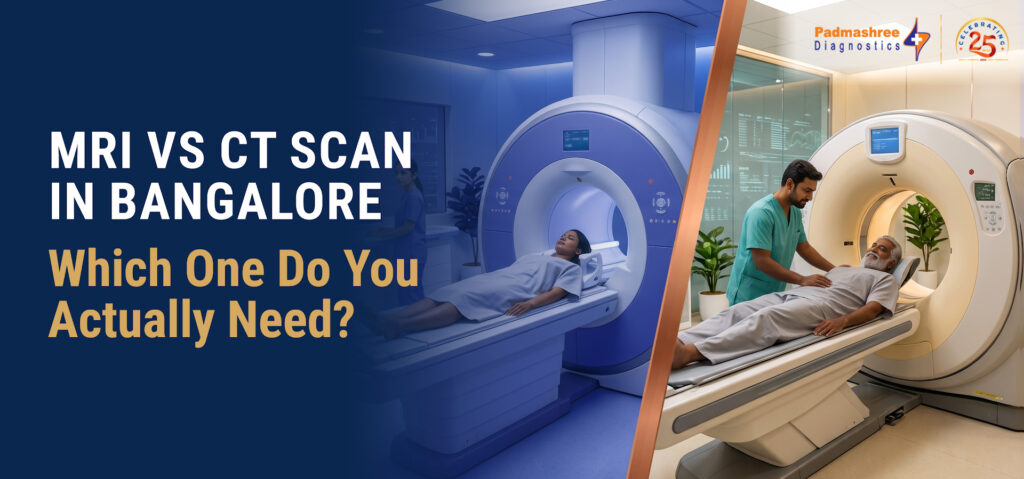
The decision between an MRI and a CT scan heavily relies on the patient’s specific clinical indication, such as whether they require rapid imaging for acute trauma or detailed evaluation of soft tissue abnormalities. This choice is further guided by the referring physician’s information, including the suspected diagnosis, the patient’s medical history, and the precise diagnostic question the doctor needs answered. Finally, the region to be scanned dictates the optimal modality; CT scans generally excel at capturing dense structures like bone and the chest cavity, whereas MRIs provide superior, high-resolution imaging for complex soft tissues like the brain, spinal cord, and joint ligaments.
Our radiologists don’t just read reports; they actively guide your study. By modifying the scan protocol based on real-time findings, they ensure no detail is missed and provide a truly comprehensive evaluation.
Padmashree Diagnostics in Vijayanagar, Bengaluru, provides comprehensive imaging services, featuring both 1.5T MRI and Multislice CT scanning capabilities on-site. Our specialized radiology team ensures precise diagnostic accuracy and timely dispatch of the reports.
Difference Between MRI and CT Scan: How Each One Works
A CT scanner works like a highly advanced, three-dimensional X-ray machine. As you lie on a motorized table, you slide through a large, donut-shaped opening where an X-ray tube rapidly rotates around your body. This rotating tube takes hundreds of quick snapshots from various angles, which a powerful computer then stitches together to create detailed, cross-sectional images.
Unlike a CT scan, an MRI (Magnetic Resonance Imaging) doesn’t use X-rays or radiation. Instead, it relies on a massive, powerful magnet and radio waves to see inside your body. Because the human body is mostly water, the scanner’s strong magnetic field acts on the tiny magnetic particles (protons) in your cells, temporarily lining them up. These particles shift and release faint energy signals as they return to their normal position. A powerful computer captures these signals and translates them into incredibly detailed, cross-sectional pictures. An MRI provides excellent clarity when examining the brain, spinal cord, muscles, and ligaments.
MRI vs CT Scan Radiation: Is MRI Safer Than CT Scan?
While a CT scan is a powerful diagnostic tool, a single scan does expose the body to ionizing radiation—roughly equal to three to five years of natural background radiation. CT protocols are optimized to prevent excessive exposure to the patient and optimize the risk to benefit. Special care is adopted to protect vulnerable patients like children. CT scans are avoided in pregnant women/ expectant mothers.
An MRI uses zero radiation, making it an incredibly safe diagnostic tool. However, the strong magnets can pose risks for patients with pacemakers, certain metal implants, or severe claustrophobia. To ensure your complete safety, the Padmashree Diagnostics team carefully screens every patient prior to stepping into the scanner.
Contrast Dye: What to Know Before a contrast scan
Certain MRI and CT protocols necessitate the use of a contrast agent to enhance the visibility of specific tissues, organs, and vasculature. CT imaging utilizes iodine-based contrast, whereas MRI employs a gadolinium-based compound. These materials can occasionally induce mild side effects or allergic reactions; hence, patients must disclose any history of allergies or kidney condition to the technologist prior to the examination.
Speed and Comfort
When time is critical, doctors rely on CT scans because they provide vital answers in just 10 to 30 minutes. While MRIs offer incredible soft-tissue detail, they take longer—up to an hour—and the enclosed machine can be uncomfortable for those with claustrophobia.
MRI vs CT Scan for Knee, Back, Brain, and Spine
| Situation | Better Choice | Why |
| Bone fractures | CT | Sharper detail on hard structures |
| Internal bleeding | CT | Speed matters in emergencies |
| Lung or chest issues | CT | Better at imaging dense, air-filled structures |
| Brain tumor | MRI | Superior soft-tissue contrast |
| Back pain, disc or nerve issues | MRI | Detailed view of the spinal cord |
| Knee injury (ligament or cartilage damage) | MRI | Best imaging for soft connective tissue |
| Cancer staging | CT/ MRI | It depends on the site and tumour to be evaluated, with CT being utilised in staging |
| Kidney stones | CT | Fast and highly accurate for stones |
When comparing the accuracy of a CT scan to an MRI, there is no single winner. The optimal modality depends entirely on the specific clinical indication and the anatomical structures being evaluated.
MRI vs CT Scan Cost
When deciding on an imaging centre, many patients naturally compare the cost of an MRI against a CT scan before booking their appointment. Fortunately, with over 200 diagnostic facilities across the city actively competing for your choice, the prices for both scans generally remain highly competitive and patient-friendly.
Standard CT imaging remains highly cost-effective, with specialized protocols like 3D reconstructions or contrast-enhanced studies carrying an additional cost. Routine MRI evaluations of the brain, spine, abdomen, and joints are generally priced higher than CT scans. Advanced MRI modalities, including whole-body imaging, MR angiography, and functional MRI, have the highest fees due to the longer acquisition times and sophisticated technology.
MRI is typically more expensive than CT imaging due to the higher capital and maintenance costs of the equipment, longer scan durations, and the need for highly trained technologists. The costs of the scan also vary based on the facility’s location, the magnetic field strength of the scanner (such as 1.5T versus 3T systems), and the necessity of contrast injection.
Ready to schedule your scan? Please contact Padmashree Diagnostics at 080-23100735 or 080-23100738. Our front desk staff provides precise cost estimates tailored to your physician’s prescription, ensuring complete billing transparency with no hidden charges.
Which Is Better MRI or CT Scan?
Which is better: an MRI or a CT scan? The answer depends on your symptoms and medical history, which is why your referring doctor or the radiologist makes the final call. If you’re unsure about your prescription, don’t hesitate to ask your doctor for clarification. The team at Padmashree Diagnostics is also readily available to explain the reasoning in simple terms and walk you through what to expect before you book your appointment.
Why Choose Padmashree Diagnostics
- Both scans under one roof – a 1.5T MRI and Multislice CT Scan, no travel between centres
- 25+ years serving Bengaluru, ISO-certified, 4.6★ Google rating – why patients search for the best MRI centre in Bangalore and choose us
- Experienced radiology team with senior consultants known for dependable reporting
- Fast turnaround with digital report access
- Patient-first process, screening for implants before every MRI
97, Vijayanagar, Bengaluru, Karnataka 560040 | 080-23100735 / 080-23100738
Monday–Saturday, 6:30 AM–8:30 PM | Sunday, 6:30 AM–12:30 PM
Frequently Asked Questions
- What is the difference between an MRI and a CT scan? CT uses X-rays for fast cross-sectional images; MRI uses a magnetic field and radio waves for sharper soft-tissue detail without radiation.
- Is MRI safer than CT scan? For radiation, yes – MRI involves none, while CT does. However, MRI carries its own restrictions around metal implants and certain devices.
- How much radiation does a CT scan have? Roughly the equivalent of three to five years of natural background exposure. However, there is no need to worry—this level of exposure is still well within safe medical limits.
- Is MRI more expensive than CT? Generally, yes, since MRI machines and technicians cost more to run.
- How long does an MRI take vs CT? CT usually takes 10 to 30 minutes; MRI typically takes 30 minutes to an hour, depending on the body part.
- Can I choose MRI instead of CT? You can discuss your preference with your doctor, but the choice is usually clinical rather than personal, since the wrong scan can miss what your doctor needs to see.
- MRI or CT scan for back pain: which is recommended? MRI generally suits back pain and disc issues best, due to its superior soft-tissue detail.
- CT scan vs MRI for brain tumor: which is preferred? Doctors typically prefer MRI for a brain tumor, since it captures far more soft-tissue detail than CT.
- Which scan for internal bleeding is preferred? Doctors typically prefer CT for internal bleeding, thanks to its speed in emergencies.
- Do I need to prepare differently for an MRI compared to a CT scan? Yes. Specific instructions are provided prior to the scan, for instance, remove metal objects and disclose implants before an MRI, fasting for a few hours before a contrast CT scan. Always follow your diagnostic centre’s instructions.

